OVERVIEW
We’re here to do the studies no one else is doing.
Future-facing, curiosity-led, and unapologetically bold—we explore what others overlook. This isn’t just research. It’s a movement to redefine what science can ask, and what healing can look like.
GET IN TOUCH to discuss your ideas.
past studies include
current studies
CURRENT STUDIES
CURRENT STUDIES
■ SET AND SETTING
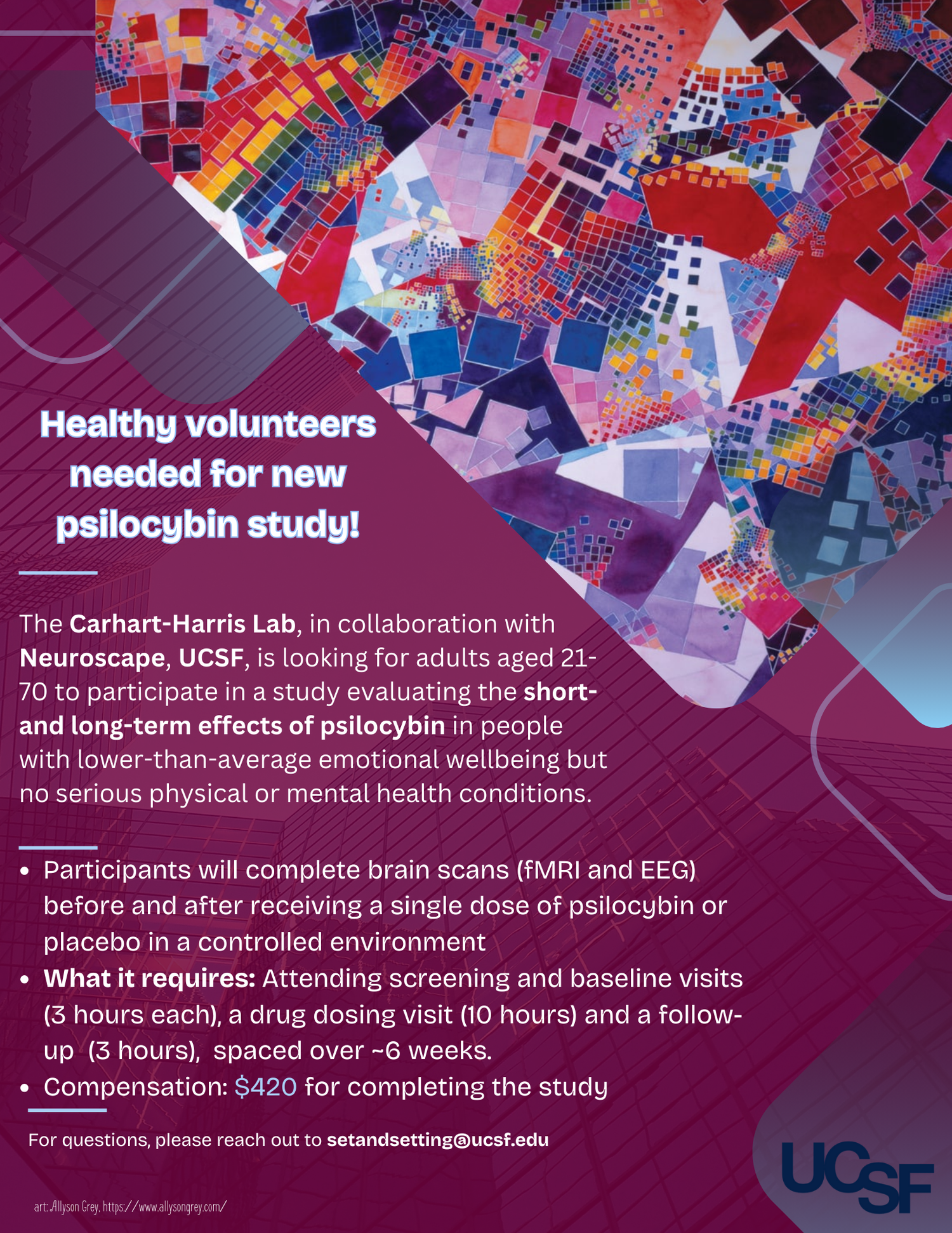
It is widely assumed that the EFFECTS OF PSYCHEDELIC SUBSTANCES CRITICALLY DEPEND ON CONTEXT - the ‘set and setting’ in which they are used. With the Set and Setting Study, we aim to test this interaction in a controlled way, by giving participants either psilocybin or a placebo in one of two different kinds of context.
The study will be taking place at the UCSF Mission Bay campus in San Francisco, and participants with lower-than-average well-being but no serious underlying physical or mental health conditions are currently being enrolled. Check if you are eligible by clicking the button below!
■ PSILOCYBIN VS. SSRI FOR DEPRESSION
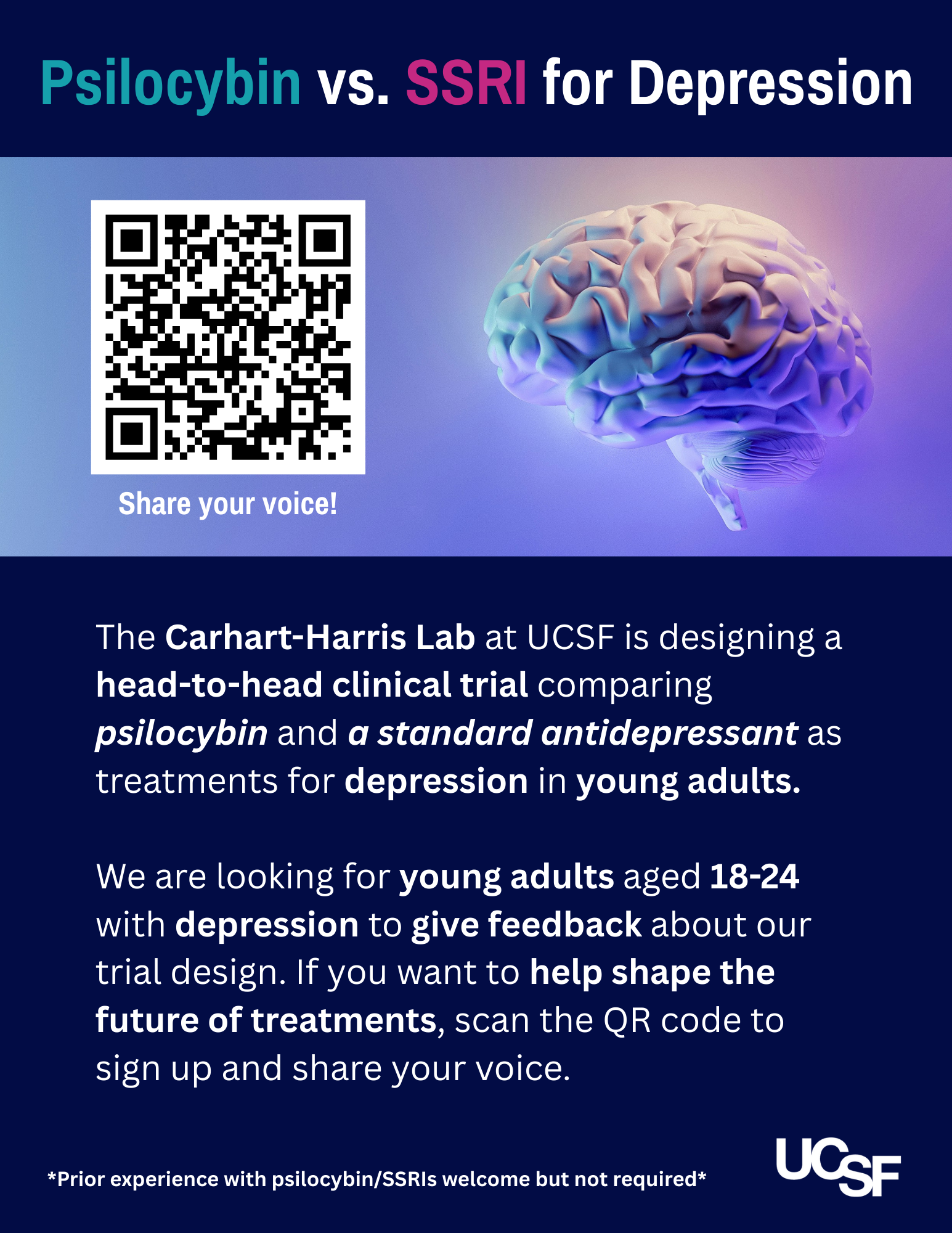
The Carhart-Harris Lab at UCSF id designing a head-to-head clinical trial comparing psilocybin and a standard antidepressant as treatments for depression in young adults.
We are looking for young adults aged 18-24 with depression to give feedback about our trial design. If you want to help shape the future of treatments, scan the QR code or click the button below to sign up and share your voice.
■ CHL GLOBAL PSYCHEDELIC SURVEY
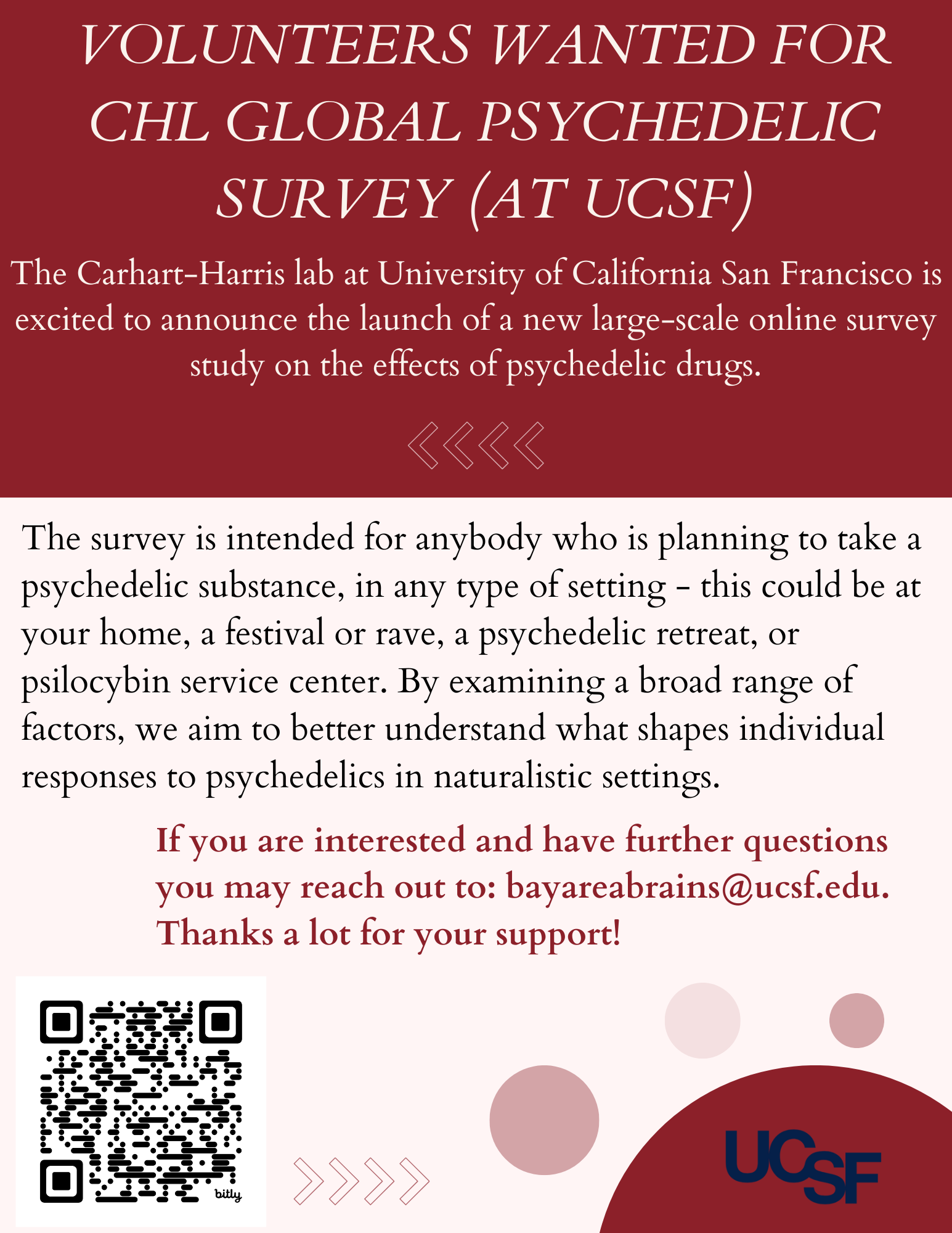
The Carhart-Harris lab at University of California San Francisco is excited to announce the launch of a new large-scale online survey study on the effects of psychedelic drugs and we are looking for volunteers.
The survey is intended for anybody who is planning to take a psychedelic substance, in any type of setting – this could be at your home, a festival or rave, a psychedelic retreat, or psilocybin service center. By examining a broad range of factors, we aim to better understand what shapes individual responses to psychedelics in naturalistic settings.
If you are interested and have further questions, please get in touch.
Three ways to contribute – one study
-
![Geometric drawing of an outline square with sections divided by vertical, horizontal, and diagonal lines.]()
short form
• ~45 minutes total
• 3 quick check-ins -
![Geometric drawing of an outline square with sections divided by vertical, horizontal, and half circle lines.]()
Long Form
• ~X minutes total
• 6 quick check-ins -
![Geometric drawing of an outline square with sections divided by vertical, horizontal, and circle lines.]()
BAY AREA BRAINS
• Long form + brain scans
• Local first-timers only